
Learning Swedish through everyday life in Åmål
During my seven-month European Solidarity Corps placement in Åmål, learning Swedish became part of understanding the community, participating in daily life, and making Sweden feel less like a temporary destination.
When I moved to Åmål for my seven-month European Solidarity Corps placement, learning Swedish became part of learning how to live in the community. The language was not separate from the volunteering experience: it was present in the municipal office, in shops and public spaces, during local activities, and in the small exchanges that gradually make an unfamiliar place feel more accessible.
My placement through Seeds of Solidarity was based with the Municipality of Åmål and Europe Direct Fyrbodal. Much of my work involved European communication, school outreach, events, mobility guidance, digital content, and community activities. English made international cooperation possible, but Swedish helped me understand more of the local setting in which that work was taking place.
Learning beyond lessons
Living in Sweden meant encountering the language every day. Signs, announcements, conversations between colleagues, practical errands, and community activities all became opportunities to recognise vocabulary and connect what I was studying with real situations.
The most useful progress often came through repetition: hearing the same phrases, noticing how people actually pronounced them, and slowly becoming more confident in familiar interactions. Swedish also made the cultural dimension of the placement more tangible. Language carries humour, habits, tone, and ways of relating to people that are difficult to experience fully through translation alone.
I currently describe my Swedish as A2. That is a basic, practical level rather than fluency, and I think it is important to present it honestly. At the same time, it represents something meaningful: the ability to move beyond complete dependence on English and begin engaging with everyday life through the local language.
Language as participation
For me, learning the language of a host country is a form of participation. Even limited Swedish signalled curiosity and respect, and it made everyday encounters less one-sided. It helped turn the placement from a period of work abroad into a deeper experience of living in Sweden.
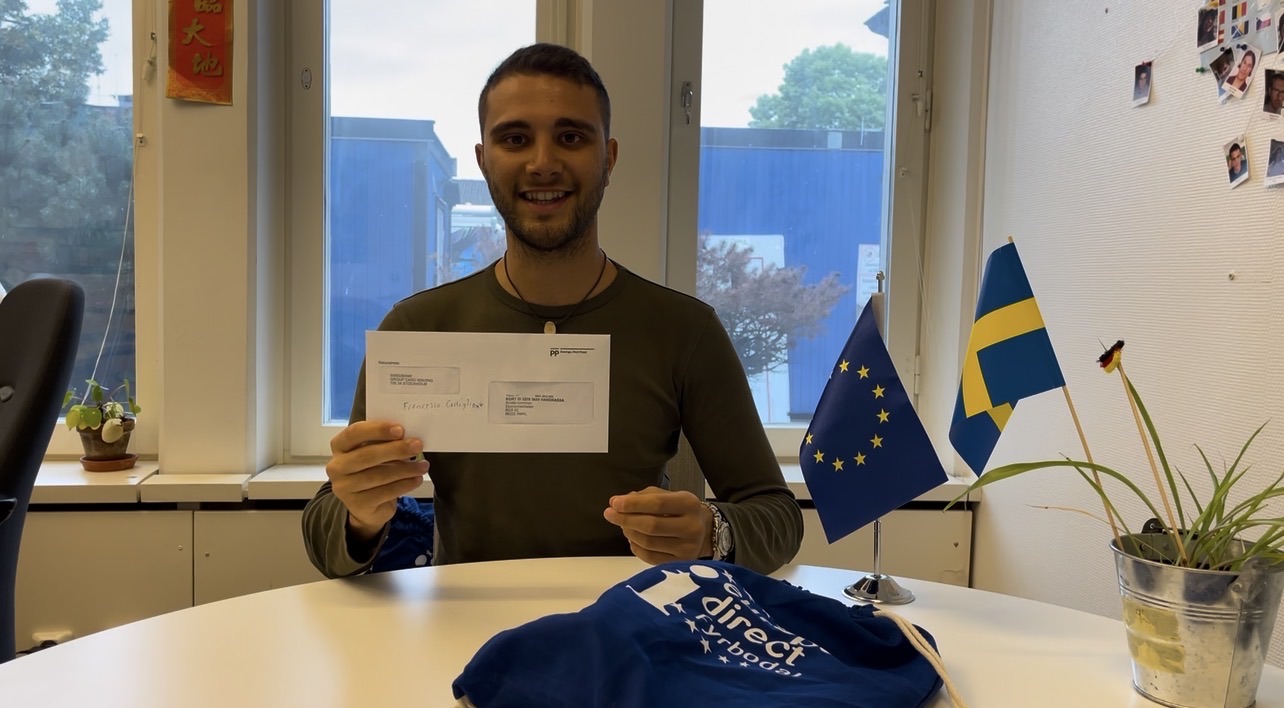
The photograph above was taken during my placement at Europe Direct Fyrbodal. The European Union and Swedish flags beside me capture an important part of the experience: European mobility opened the door, while learning Swedish helped me engage more closely with the place and the people around me.
Language learning is recorded among the outcomes of my Seeds of Solidarity Youthpass. You can also see Swedish alongside the other languages I use and continue to study in my CV.