
The Last Witness: carrying memory between generations
Reflections from Memory of Totalitarianism in Hungary, where historical sites, international dialogue, and a final visual project became ways of asking how memory survives.
The Shoes on the Danube Bank memorial is quiet, direct, and difficult to pass without stopping. Standing beside the river in Budapest, it became one of the places through which I began to understand the purpose of Memory of Totalitarianism: not only to study a historical period, but to ask how Europe remembers violence, how different countries tell the past, and what those choices mean for democracy today.
Joining the Slovenian team
From 22 to 31 July 2026, I participated in the Hungarian edition of the international youth exchange Memory of Totalitarianism. I joined the Slovenian team through Socialna Akademija in a group of 26 participants from Germany, Hungary, Poland, and Slovenia.
The exchange focused on the totalitarian systems that marked twentieth-century Europe—fascism, Nazism, and communism—with particular attention to the 1956 Hungarian uprising, the decades of Goulash Communism, and the fall of the Iron Curtain in 1989. It asked us to look beyond dates and political labels and to consider how these experiences continue to shape public memory, identity, and democratic life.
Moving through places, not only dates
Our programme was based around Budapest and took us to Recsk, Dunaújváros, and Sopron. Each place offered a different way of approaching memory: through museums and memorials, through the physical traces of repression and political change, and through conversations about how history is interpreted in public life.
The programme included a visit to the House of Terror, content-based workshops, group discussions, study visits, arts-based work, group reflection, team-building activities, and the development of a final creative output. Moving between places made the historical timeline feel less abstract. It also showed how the same period can be remembered differently depending on the community, institution, or national perspective telling the story.
The exchange was hosted by Kispesti Waldorf School and connected partners from Hungary, Germany, Poland, and Slovenia, including Socialna Akademija, Kolegium Europy Wschodniej, and Volksbund Deutsche Kriegsgräberfürsorge e.V. These details are now also documented through the Youthpass issued after the activity.
What the international group added
The exchange was not a traditional history course. Its value came from comparing perspectives within an international group. Participants brought different family histories, educational backgrounds, and national narratives into the same room. That made discussion more complex, but also more useful: memory is not neutral, and democratic dialogue requires the patience to examine disagreement without reducing it to slogans.
For me, the experience connected historical learning with questions that remain current. How do societies recognise victims? How do they talk about responsibility? What happens when historical memory is simplified or used politically? And how can young people protect spaces for critical thinking, dignity, peace, and coexistence?
My final product: The Last Witness: The Hands of Memory
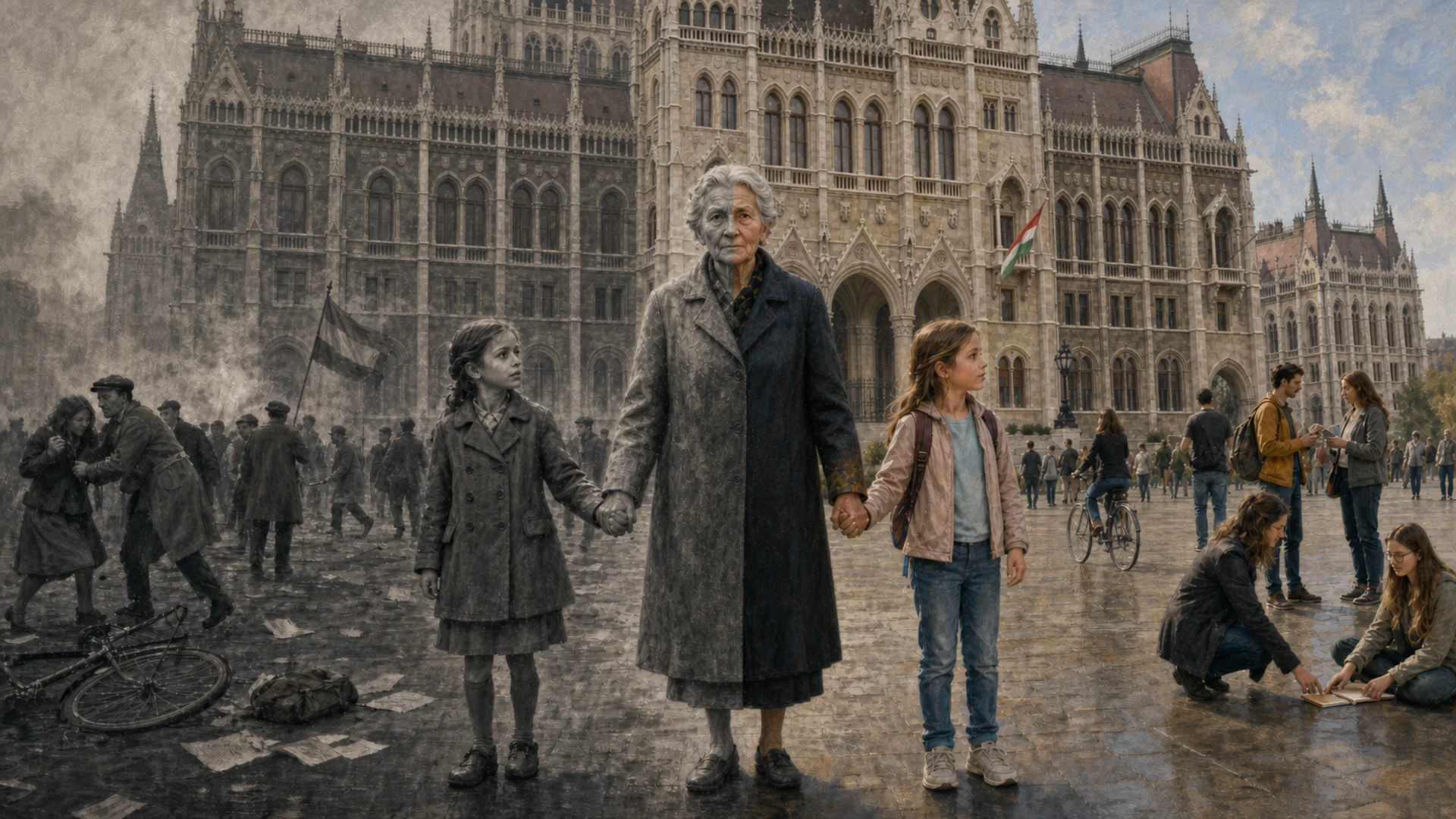
My final product for the exchange was a visual work set in Kossuth Lajos Square before the Hungarian Parliament. I called it The Last Witness: The Hands of Memory.
The image brings together three generations and two historical moments within one continuous place. On the left, rendered in monochrome, a young girl stands amid the uncertainty and aftermath of 1956. She represents the grandmother as a child—the person who first witnessed these events and carried their memory forward.
On the right, in the colours of the present, another young girl represents the granddaughter and the generation that will inherit a freedom it did not have to fight for directly.
Between them stands the grandmother, holding both girls’ hands. Her body and face are divided between monochrome and colour, embodying two identities and two periods within one figure. Her left half remains connected to the world that shaped her; her right half belongs to the present she helped make possible.
The grandmother alone looks directly at the viewer. Her gaze turns the image into an act of transmission: she is not simply remembering the past but asking us to receive it.
The Parliament remains continuous behind all three figures, reminding us that history and contemporary life occupy the same physical ground. The joined hands form an unbroken human chain—from the child who experienced history, through the woman who preserved its memory, to the child who must carry it forward.
When the final witnesses are gone
The central question of the work is what happens when the final witnesses are no longer here to tell us what they saw. Documents, monuments, and institutions matter, but memory also survives through human choices: someone must listen, interpret, and decide to carry it onward.
That idea became my main conclusion from the exchange. Remembering is not passive. It is a responsibility between generations, and it depends on the willingness to place the past into the hands of those who come next.
The Last Witness: The Hands of Memory asks us to consider that responsibility directly: memory survives only when one generation chooses to place it into the hands of the next.